Alexander Skarsgård Was Made For Olivia Colman In Final Wicker Trailer
- A Bizarre Premise Finds Its Voice
- The Directors’ Unconventional Vision
- Olivia Colman’s Unusual Role
- Alexander Skarsgård as Wicker Ideal
- Peter Dinklage’s Craftsmanship on Screen
- Trailer Tone Shifts From Rude to Tender
- Anticipation Builds Around a Singular Film
The buzz is electric. A new trailer has just dropped, and it feels like a secret whispered among cinephiles.
The short clip promises a film that straddles mischief and affection in equal measure. It introduces a story that could only exist on the fringe of imagination, where a fisherwoman commissions a husband fashioned from wicker, and the result looks both absurd and oddly moving.
A Bizarre Premise Finds Its Voice
The central conceit revolves around an unnamed fisherwoman, played by Olivia Colman, who turns to a reclusive artisan for a very specific request. Peter Dinklage’s character is the craftsman who agrees to shape a husband out of woven wood, molding the figure in the likeness of Alexander Skarsgård. The notion of a spouse built from pliant fibers, yet modeled after a real‑world heartthrob, reads like a modern fable about desire and fabrication. It is a story that invites the audience to wonder how love can be sculpted, twisted, and perhaps even purchased.
The Directors’ Unconventional Vision
Behind the camera sit the writer‑directors Alex Huston Fischer and Eleanor Wilson. Their partnership previously delivered the 2020 feature Save Yourselve, a film that already hinted at a taste for the off‑beat. In this new project they push the envelope further, blending elements of folk legend with contemporary humor. Their script treats the surreal premise with a lightness that prevents it from feeling forced, while still allowing moments of genuine tenderness to surface. The duo’s ability to balance the ridiculous with the heartfelt shines through in the snippets revealed so far.
Olivia Colman’s Unusual Role
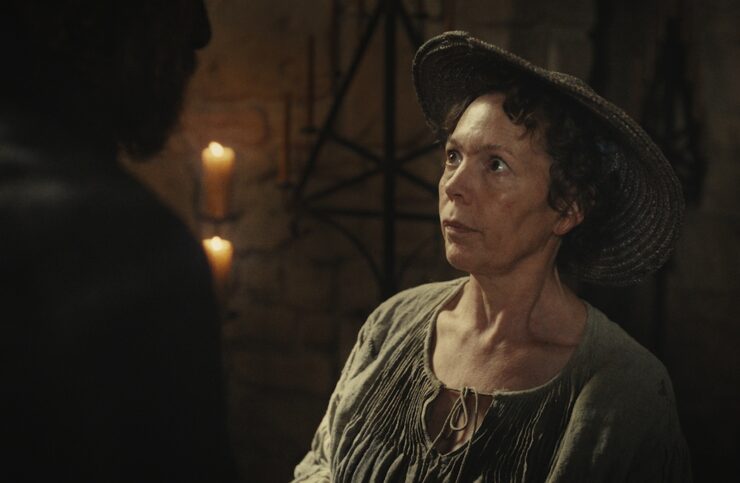
Olivia Colman steps into a part that diverges sharply from the regal or grounded characters that have defined much of her career. As the fisherwoman, she radiates a mix of practicality and yearning, navigating the sea‑salted world she inhabits while dreaming of companionship. The trailer captures her in quiet moments, eyes scanning the horizon, juxtaposed with scenes of her negotiating the terms of her unconventional marriage. Colman’s performance hints at a layered portrayal, where humor masks a deeper longing for connection, and where the line between reality and imagination blurs.
Alexander Skarsgård as Wicker Ideal
Although Alexander Skarsgård does not appear on screen, his likeness dominates the narrative. The crafted husband takes his facial features, his posture, and the magnetic charm that have made him a cultural icon. The visual of a wicker figure bearing his recognizable silhouette creates a surreal tableau that is both comic and oddly intimate. The film seems to ask whether an idealized image can ever satisfy the messy cravings of a real person, and the trailer teases that question without offering an easy answer.
Peter Dinklage’s Craftsmanship on Screen
Peter Dinklage assumes the role of the artisan who transforms raw reeds into a living sculpture. In the brief footage, his hands move with deliberate patience, coaxing strands into the outline of a man. The process is shown as both meticulous and lyrical, suggesting a reverence for the act of creation. Dinklage’s presence lends gravitas to the otherwise whimsical premise, grounding the fantasy in a tangible skill. His character’s dialogue, hinted at in the trailer, hints at a philosophical bent, implying that the act of building a husband is as much about shaping desire as it is about shaping wood.
Trailer Tone Shifts From Rude to Tender
The first glimpse of the film arrived as a raucous, unapologetically horny romp, reveling in its own audacity. The new final trailer, however, pulls back the curtain to reveal a softer undercurrent. Scenes of quiet sunrise over water replace the earlier overt jokes, while lingering close‑ups of Colman’s face suggest an emotional core beneath the absurdity. The shift does not erase the film’s bawdy spirit; instead, it layers it with moments of vulnerability that make the wild premise feel more human. The combination of playful provocation and gentle sentiment creates a tonal balance that feels both fresh and inviting.
Anticipation Builds Around a Singular Film
The response to the trailer has been swift, with early commentary labeling the work as the “horniest, most tender film of the year.” That paradoxical praise captures the dual nature of the story, where lewd humor and sincere affection coexist. Black Bear, the company associated with the project, appears poised to bring this unconventional tale to a wider audience. As the final trailer circulates, viewers are left with a sense that they are about to witness something truly singular, a movie that dares to ask whether love can be handcrafted, and whether the answer lies somewhere between the absurd and the heartfelt. The anticipation is palpable, and the promise of a film that embraces both the ridiculous and the profound has already secured its place as a curiosity that many will be eager to explore.